
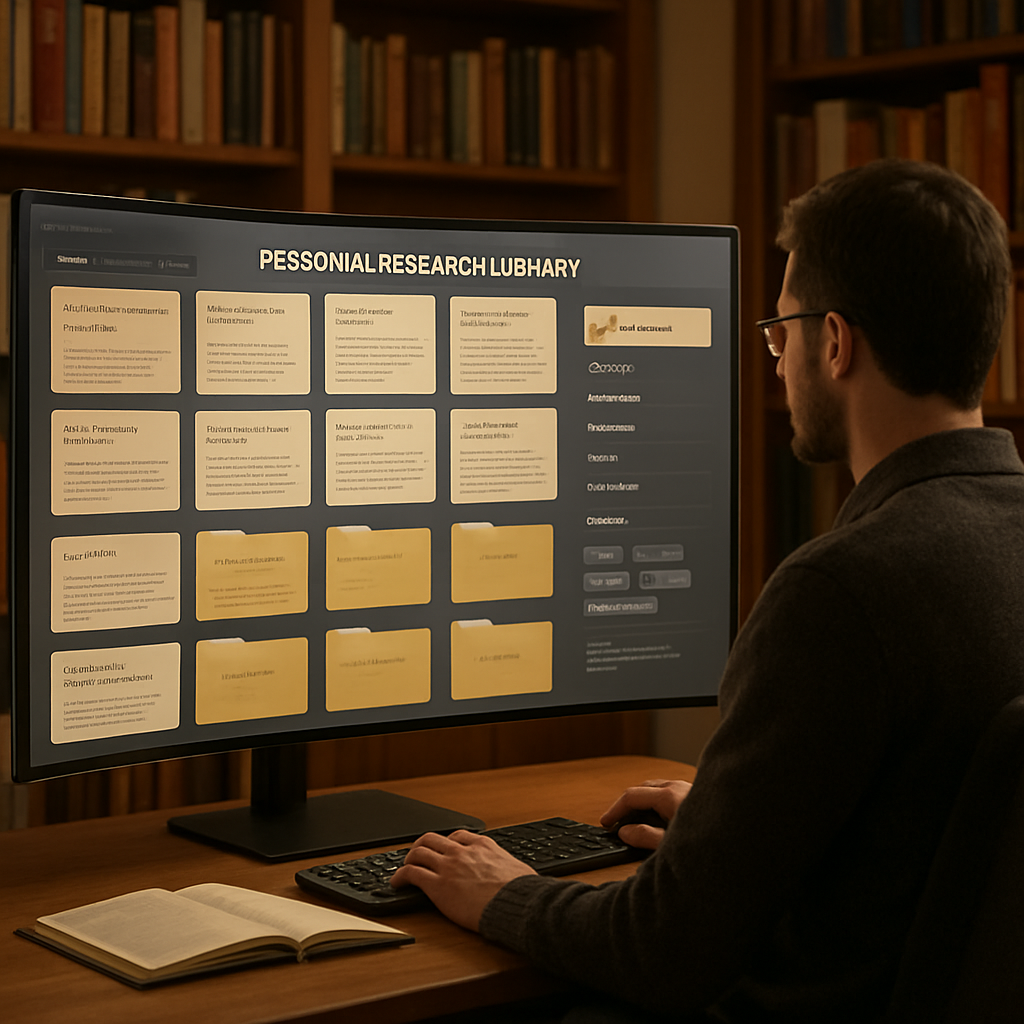
Building Your Personal Research Library with QuillWizard
“I know I downloaded that PDF—where did I put it?”
—Every grad student ever, 24 hours before a submission deadline
Messy folders, cryptic filenames, and half-remembered citations plague researchers at every career stage. Traditional reference managers help, but they often:
- Require clunky desktop apps with steep learning curves.
- Separate search and storage—forcing manual import/export steps.
- Break under PDF chaos when filenames don’t match metadata.
- Lack AI assistance for tagging, deduplication, and quick summarization.
QuillWizard’s Libraries module fixes these pain points with a seamless, cloud-based solution that integrates directly with its AI search, writing, and knowledge-management ecosystem.
In this article (≈3,600 words) you will learn to:
- Capture papers on the fly from any QuillWizard search result.
- Bulk-import references via DOI, PubMed ID, title, or PDF drag-and-drop.
- Tag, rate, and annotate articles for lightning-fast retrieval.
- Use AI tools to auto-summarize papers and generate reference metadata.
- Sync your library across devices and share with collaborators.
- Insert citations directly into your writing with one keystroke.
By the end, you’ll have a well-structured personal library that scales from your first semester to tenure review—no more hunting for lost PDFs during the midnight crunch.
1 | Why a Clean Research Library Matters
1.1 Recall vs. Recognition
Human memory favors recognition (“I’ll know that title when I see it”)—but only if we can resurface the item. Disorganized files sabotage this strength.
1.2 Writing Efficiency
Each citation you scramble for during drafting costs time and breaks writing flow. A curated library plus integrated citation picker saves minutes per citation—hours per paper.
1.3 Research Integrity
Duplicate or outdated PDFs risk mis-citing retracted or superseded work. Library deduplication and update notifications keep your references current.
1.4 Collaborative Transparency
Shared libraries mean co-authors see exactly which sources underpin each claim, smoothing peer reviews and thesis committees.
2 | QuillWizard Libraries at a Glance
| Feature | Classic Reference Manager | QuillWizard Libraries |
|---|---|---|
| Browser-native | Often desktop-only | 100 % web, sync everywhere |
| One-click save from search | Usually manual import | Integrated bookmark button |
| AI metadata extraction | Limited OCR | PDF → full citation via AI |
| Tagging & rating | Basic | Multi-tag, color labels, relevance stars |
| Inline PDF viewer | Sometimes | Built-in with highlight → Vault save |
| Citation picker in editor | Plugin needed | Native “@” autocomplete |
| Knowledgebase cross-link | Rare | Papers can feed custom knowledgebases |
| Collaboration | Paid tiers | Free team libraries (limits apply) |
QuillWizard fuses discovery, storage, annotation, and citation into a single, AI-augmented workspace.
3 | Capturing Papers: From Search to Library in One Click
3.1 Using the Bookmark Icon
Every result in /search sports a 💾 bookmark. Click it to open the Save Publication dialog:
- Select Library (default: My Library).
- Add Tags (new or existing).
- Set Relevance Stars (1–5).
- Optional Note (why it matters).
Hit Save—the article’s metadata enters your library, and if the PDF is open-access, it auto-downloads for full-text viewing.
3.2 Bulk-Adding from Multi-Query Results
After a broad search:
- Tick multiple checkboxes.
- Click Batch Save → choose library, common tags.
- QuillWizard merges duplicates and adds all in one shot.
Tip: Use a tag macro like
topic/gut-brainto group related articles automatically.
4 | Importing References En Masse
4.1 Search Papers Dialog
Navigate to Libraries → Add → Search Papers. You can:
- Paste DOIs, PMIDs, or titles (one per line).
- Choose the retrieval source (CrossRef, PubMed).
- Click Import—QuillWizard fetches full metadata and PDFs where available.
4.2 Drag-and-Drop PDFs
Drop any number of PDFs into the dialog. QuillWizard:
- Uses machine-learning models to extract title, authors, date.
- Hits CrossRef to fetch missing fields.
- Lets you confirm matches, then adds them.
4.3 RIS/BibTeX Upload
Got an export from a legacy manager? Upload .ris or .bib; QuillWizard parses and stores each entry.
5 | Organizing Your Library
5.1 Tags & Hierarchies
Tags in QuillWizard support prefixes (method/statistics, organism/mouse). Use them to create pseudo-folders without locking papers into one location.
5.2 Smart Collections
Define rules like:
Field = "Neuroscience"
AND Year >= 2023
AND Tag CONTAINS "CRISPR"
QuillWizard auto-updates the collection as new papers meet criteria—ideal for staying current.
5.3 Color Labels & Star Ratings
Color labels denote reading priority (e.g., red = must-read, blue = supporting). Star ratings mark relevance to your thesis or grant.
5.4 Duplicate & Version Control
Click Tools → Find Duplicates. QuillWizard compares DOIs and fuzzy titles, suggesting merges. If a preprint evolves into a peer-reviewed version, it links editions so you cite the latest.
6 | Deepening Understanding within the Library
6.1 Inline PDF Viewer
Click any title to open the PDF in a split-pane viewer. You can:
- Highlight passages (yellow, green, pink).
- Add comments linked to text spans.
- Save highlighted snippets to the Answer Vault.
6.2 AI Paper Summaries
Hit “AI Summary” to generate:
- Objectives
- Methods snapshot
- Key findings
- Limitations
Copy summaries into notes or share with lab-mates.
6.3 Quick BibTeX & CSL Export
Need to submit to a journal with Vancouver style? Select papers → Export → CSL JSON or BibTeX.
7 | Writing with Your Library—Citations in One Keystroke
7.1 Citation Picker
Inside the QuillWizard Write editor:
- Type @ and a keyword (
@vagus,@Smith2024). - Autocomplete shows matching entries with year and authors.
- Press Enter to insert.
The reference list auto-builds at the cursor or end of document, formatted per your chosen style (APA, MLA, IEEE, Vancouver, etc.).
7.2 Cite Multiple Papers
Type @[term1 + term2] to insert grouped citations—handy when summarizing consensus.
7.3 Switch Styles with One Click
Document → Settings → Citation Style. QuillWizard rewrites every in-text citation and reference list accordingly—a lifesaver when resubmitting to another journal.
8 | Collaboration Features
8.1 Shared Libraries
Invite collaborators via email:
- Viewer: read, cite.
- Editor: add, tag, annotate.
- Owner: full control.
Teams see real-time updates and annotations—ideal for multi-author papers.
8.2 Comment Threads
Start a thread on any paper (“Should we replicate this experiment?”). Mention teammates (@alex) to trigger notifications.
8.3 Contribution Log
Version history shows who added or edited each entry—useful for accountability in lab groups.
9 | Integration with Knowledgebases & Vault
9.1 Feeding Knowledgebases
Create a custom knowledgebase (e.g., “CRISPR Off-Target Effects”) and select papers from Library → Add to KB. QuillWizard indexes full text for question-answering specific to that corpus.
9.2 Vault Synergy
Highlights saved from PDFs appear in your Answer Vault. Filter by tag to retrieve supporting evidence during writing.
10 | Real-World Workflow: Master’s Thesis Example
Scenario: Liam, a master’s student, must write a thesis on “Machine-Learning-Driven Protein Structure Prediction.”
- Search & Capture – Uses QuillWizard search queries + bookmarks 120 papers, tagging core vs. peripheral.
- Bulk Import – Drag-drops PDFs from advisor’s Dropbox; AI fills metadata.
- Organize – Creates smart collections: Year ≥ 2023 & Tag: core.
- Summarize – Reads AI summaries, highlights methods; saves to Vault.
- Cite While Writing – Uses citation picker to drop references without switching windows.
- Collaborate – Shares library with advisor, who adds two seminal reviews.
- Finish – Exports BibTeX for LaTeX submission. Thesis review committee praises thorough citation coverage.
Time saved: ~40 hours compared to manual workflow.
11 | Best Practices & Pro Tips
| Tip | Benefit |
|---|---|
| Standardize Tags Early | Avoid tag bloat (e.g., use singular nouns) |
| Rate Relevance on Capture | Reduces decision fatigue later |
| Weekly Deduplication | Prevents library bloat |
| Use Smart Collections | Passive monitoring of new literature |
| Archive Less Relevant Papers | Keeps main library lean |
| Leverage AI Summaries Before Reading Full PDF | Decide if worth deep dive |
| Back-up Exports Monthly | Extra safety (+ Zenodo DOI if public) |
12 | Limitations & Roadmap
- Citation Styles: ~30 styles supported now; AMA and ACS coming soon.
- Proprietary PDFs: Auto-download limited by publisher licensing; manual upload still possible.
- Local File Sync: Desktop sync app (offline + local backup) in beta.
- Mobile Annotation: Planned iOS/Android PDF markup.
Ready to Tame Your Paper Chaos?
Build a smarter, searchable, AI-assisted research library in minutes—no desktop installs, no tangled folders.
Create Your Library Free13 | Conclusion: From Chaos to Curated Knowledge
A well-organized personal research library is the backbone of efficient, credible scholarship. With QuillWizard Libraries, you can:
- Capture articles seamlessly from search or PDFs.
- Organize with tags, ratings, and smart collections.
- Understand faster via AI summaries and inline highlights.
- Write & Cite without ever leaving the browser.
- Collaborate with teammates in real time.
Stop wasting hours hunting for lost papers. Start building a living, breathing knowledge hub that grows with your academic journey. QuillWizard puts the library science—and the AI—at your fingertips, so you can focus on what truly matters: discovering and communicating new knowledge. 📚🚀
Going Deeper: The Craft Behind the Research
Great research is not produced by chance or talent alone. It is produced by researchers who have developed disciplined habits of inquiry, a commitment to intellectual honesty, and the resilience to sustain effort through the inevitable difficulties of original work. Understanding the craft elements that distinguish high-impact research from competent research is valuable for anyone who wants to build a productive and influential scholarly career.
The most important craft element is clarity of research question. Vague research questions produce vague results that are difficult to interpret and difficult to build on. A sharply defined research question specifies exactly what is being asked, at what level of analysis, using which measurement approach, and under what conditions. Arriving at this level of specificity typically requires multiple rounds of refinement, each guided by engagement with the literature and with preliminary data. The time invested in sharpening the research question pays dividends in every subsequent stage of the research process: data collection is more focused, analysis is more tractable, and results are more interpretable and more citable.
The second craft element is methodological transparency. Research that cannot be evaluated for methodological adequacy cannot be effectively built upon, because readers cannot assess whether the findings are likely to generalise or whether methodological choices that are invisible in the paper may have influenced the results. Methodological transparency requires not just reporting what was done but explaining why: why this sample, why this measure, why this analysis rather than a plausible alternative. This explanatory transparency serves two functions: it allows readers to evaluate the adequacy of the choices, and it demonstrates that the researcher has thought carefully about the implications of their methodological decisions rather than simply defaulting to familiar or convenient approaches.
The third craft element is appropriate scope. The most effective research papers address a clearly defined question with sufficient depth to produce a genuinely informative answer. Scope that is too broad produces results that are too thin to be informative about any specific question; scope that is too narrow produces results that are informative but trivially so. Finding the right scope requires the ability to resist the temptation to answer every question raised by the data, and to focus instead on answering one question well. This focus is a form of intellectual discipline that is difficult to develop but becomes more natural with practice.
The Writing Phase: From Analysis to Argument
The transition from completed analysis to written paper is a transition from the mode of scientist to the mode of author, and it requires a different set of skills. The scientist's job is to produce accurate findings; the author's job is to make those findings intelligible and compelling to a specific audience. These are complementary but distinct tasks, and researchers who are excellent scientists sometimes struggle as authors because they do not distinguish between them clearly.
The author's primary task is argument construction: developing a coherent, evidence-based argument that answers the research question and situates the answer in the context of existing knowledge. An academic paper is not a report of everything that was done and found; it is a carefully constructed argument in which the evidence is marshalled in support of a specific claim. Evidence that does not serve the argument — no matter how interesting in itself — should be moved to supplementary materials or saved for a future paper. The discipline of argument construction is what separates a well-written paper from a data dump, and it is what makes a paper useful to readers who want to build on it.
Each section of the paper serves a specific function in the argument. The introduction establishes why the research question matters and what gap in knowledge the current paper addresses. The methods section establishes that the approach is adequate for the question asked and sufficient for the claims made. The results section presents the evidence honestly and completely, including evidence that complicates the argument. The discussion section interprets the evidence, addresses the limitations that affect the strength of the conclusions, and identifies the implications for future research and practice.
The most common weakness in academic paper writing is a mismatch between the strength of the evidence and the strength of the conclusions. Conclusions that outrun the evidence — claiming certainty where the data support only tentative conclusions, generalising to populations beyond the sample, or attributing causal relationships to correlational data — are a form of intellectual dishonesty that erodes the credibility of the research. Maintaining strict discipline about the relationship between evidence and conclusion, even when more confident conclusions would be more impressive or more publishable, is a fundamental requirement of scientific integrity.
Building on Your Research: From Publication to Impact
Publication is not the end of the research process; it is the beginning of the contribution to the field. A published paper that no one reads, cites, or builds on has made no impact regardless of its quality, and the effort invested in it is wasted from the perspective of the field's knowledge development. Understanding how to translate the quality of published work into genuine impact on the field is therefore as important as producing that quality.
The primary driver of paper impact is the quality and significance of the research question and findings. Papers that address important questions with rigorous methods and produce clear, interpretable results attract citations because other researchers find them useful as a basis for their own work. Marketing and promotion can amplify the reach of a good paper, but they cannot substitute for quality; papers that are heavily promoted but address questions of limited significance or use flawed methods will receive initial attention but will not sustain citation growth.
Presentation at conferences and seminars, particularly in the period immediately after publication, increases the visibility of new work among researchers who are actively working in the area and are therefore most likely to cite it. The personal relationships developed through conference attendance and seminar presentation often directly produce citations: a researcher who knows about your work and has discussed it with you personally is more likely to cite it than one who encountered it only through a database search. Building these relationships is therefore an investment not just in social capital but in the impact of specific papers.
Engagement with the broader public — through press releases, accessible blog posts, policy briefs, or social media — can extend the reach of research beyond the academic community and contribute to impact in policy and practice. This kind of public engagement is increasingly recognised by research funders and institutions as a valuable dimension of scholarly contribution, and the skills required for effective public communication of research are distinct from and complementary to the skills required for academic publication. Developing them is a worthwhile investment for researchers whose work has implications beyond the academy.
Going Deeper: The Craft Behind the Research
Great research is not produced by chance or talent alone. It is produced by researchers who have developed disciplined habits of inquiry, a commitment to intellectual honesty, and the resilience to sustain effort through the inevitable difficulties of original work. Understanding the craft elements that distinguish high-impact research from competent research is valuable for anyone who wants to build a productive and influential scholarly career.
The most important craft element is clarity of research question. Vague research questions produce vague results that are difficult to interpret and difficult to build on. A sharply defined research question specifies exactly what is being asked, at what level of analysis, using which measurement approach, and under what conditions. Arriving at this level of specificity typically requires multiple rounds of refinement, each guided by engagement with the literature and with preliminary data. The time invested in sharpening the research question pays dividends in every subsequent stage of the research process: data collection is more focused, analysis is more tractable, and results are more interpretable and more citable.
The second craft element is methodological transparency. Research that cannot be evaluated for methodological adequacy cannot be effectively built upon, because readers cannot assess whether the findings are likely to generalise or whether methodological choices that are invisible in the paper may have influenced the results. Methodological transparency requires not just reporting what was done but explaining why: why this sample, why this measure, why this analysis rather than a plausible alternative. This explanatory transparency serves two functions: it allows readers to evaluate the adequacy of the choices, and it demonstrates that the researcher has thought carefully about the implications of their methodological decisions rather than simply defaulting to familiar or convenient approaches.
The third craft element is appropriate scope. The most effective research papers address a clearly defined question with sufficient depth to produce a genuinely informative answer. Scope that is too broad produces results that are too thin to be informative about any specific question; scope that is too narrow produces results that are informative but trivially so. Finding the right scope requires the ability to resist the temptation to answer every question raised by the data, and to focus instead on answering one question well. This focus is a form of intellectual discipline that is difficult to develop but becomes more natural with practice.
The Writing Phase: From Analysis to Argument
The transition from completed analysis to written paper is a transition from the mode of scientist to the mode of author, and it requires a different set of skills. The scientist's job is to produce accurate findings; the author's job is to make those findings intelligible and compelling to a specific audience. These are complementary but distinct tasks, and researchers who are excellent scientists sometimes struggle as authors because they do not distinguish between them clearly.
The author's primary task is argument construction: developing a coherent, evidence-based argument that answers the research question and situates the answer in the context of existing knowledge. An academic paper is not a report of everything that was done and found; it is a carefully constructed argument in which the evidence is marshalled in support of a specific claim. Evidence that does not serve the argument — no matter how interesting in itself — should be moved to supplementary materials or saved for a future paper. The discipline of argument construction is what separates a well-written paper from a data dump, and it is what makes a paper useful to readers who want to build on it.
Each section of the paper serves a specific function in the argument. The introduction establishes why the research question matters and what gap in knowledge the current paper addresses. The methods section establishes that the approach is adequate for the question asked and sufficient for the claims made. The results section presents the evidence honestly and completely, including evidence that complicates the argument. The discussion section interprets the evidence, addresses the limitations that affect the strength of the conclusions, and identifies the implications for future research and practice.
The most common weakness in academic paper writing is a mismatch between the strength of the evidence and the strength of the conclusions. Conclusions that outrun the evidence — claiming certainty where the data support only tentative conclusions, generalising to populations beyond the sample, or attributing causal relationships to correlational data — are a form of intellectual dishonesty that erodes the credibility of the research. Maintaining strict discipline about the relationship between evidence and conclusion, even when more confident conclusions would be more impressive or more publishable, is a fundamental requirement of scientific integrity.
Building on Your Research: From Publication to Impact
Publication is not the end of the research process; it is the beginning of the contribution to the field. A published paper that no one reads, cites, or builds on has made no impact regardless of its quality, and the effort invested in it is wasted from the perspective of the field's knowledge development. Understanding how to translate the quality of published work into genuine impact on the field is therefore as important as producing that quality.
The primary driver of paper impact is the quality and significance of the research question and findings. Papers that address important questions with rigorous methods and produce clear, interpretable results attract citations because other researchers find them useful as a basis for their own work. Marketing and promotion can amplify the reach of a good paper, but they cannot substitute for quality; papers that are heavily promoted but address questions of limited significance or use flawed methods will receive initial attention but will not sustain citation growth.
Presentation at conferences and seminars, particularly in the period immediately after publication, increases the visibility of new work among researchers who are actively working in the area and are therefore most likely to cite it. The personal relationships developed through conference attendance and seminar presentation often directly produce citations: a researcher who knows about your work and has discussed it with you personally is more likely to cite it than one who encountered it only through a database search. Building these relationships is therefore an investment not just in social capital but in the impact of specific papers.
Engagement with the broader public — through press releases, accessible blog posts, policy briefs, or social media — can extend the reach of research beyond the academic community and contribute to impact in policy and practice. This kind of public engagement is increasingly recognised by research funders and institutions as a valuable dimension of scholarly contribution, and the skills required for effective public communication of research are distinct from and complementary to the skills required for academic publication. Developing them is a worthwhile investment for researchers whose work has implications beyond the academy.