
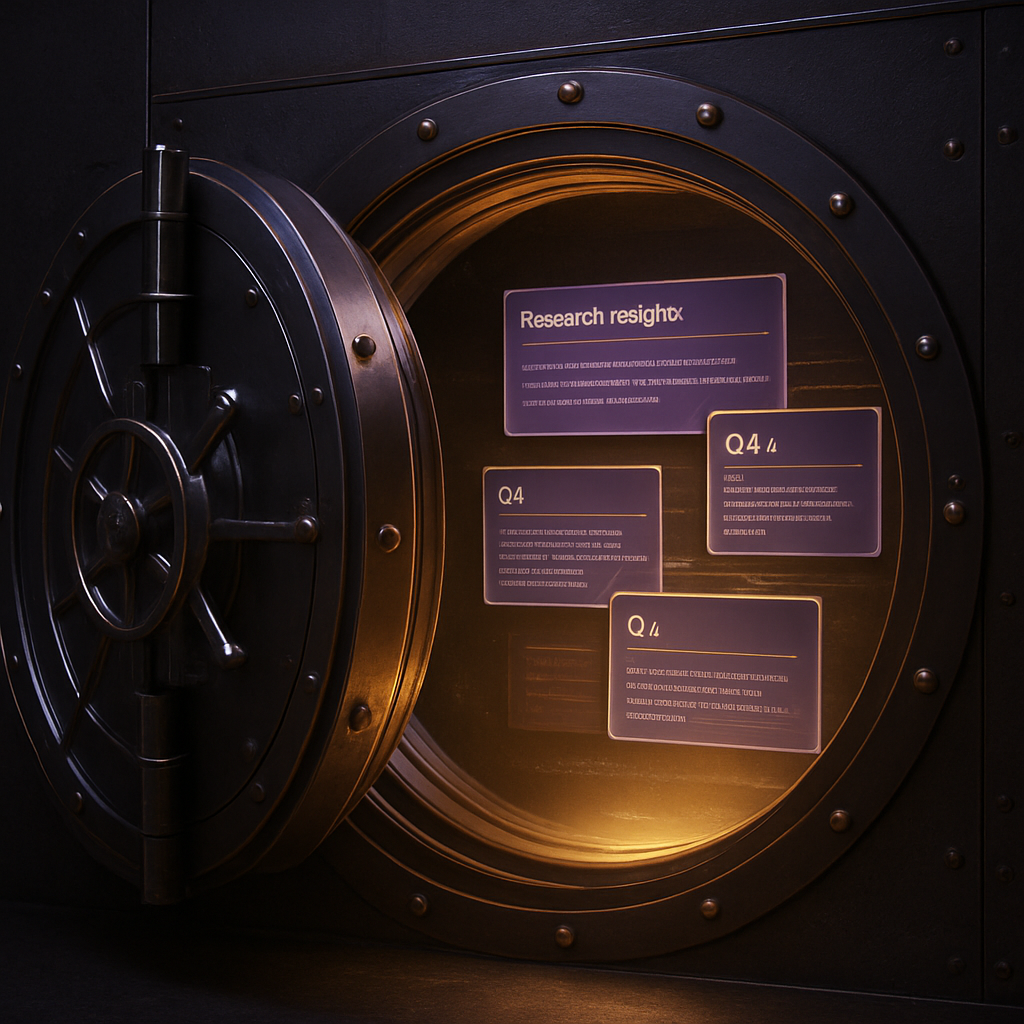
Never Lose an Insight: Organize Q&As in an Answer Vault
“I knew QuillWizard had synthesized the perfect paragraph on vagus-nerve signaling last month—but after twenty minutes digging through chat history, I gave up.”
—A neurobiology postdoc before discovering the Answer Vault
If you’ve used QuillWizard’s Ask-a-Question feature, you’ve likely experienced the thrill of an instant, evidence-backed answer—complete with inline citations. But what happens days or weeks later when you need that same insight for a paper, a lecture, or a reviewer rebuttal? Without a systematic capture method, even the most brilliant AI-generated summaries vanish into chat logs, Slack threads, or sticky-note oblivion.
Enter the Answer Vault—QuillWizard’s dedicated module for storing, tagging, and retrieving every AI answer, manual summary, or highlight you deem valuable. Think of it as a personal Stack Overflow, Evernote, and Zotero rolled into one—purpose-built for academic rigor.
In this deep-dive (≈3,800 words) you’ll learn to:
- Save answers from Q&A, Search, or Knowledgebase sessions in one click.
- Tag entries with project codes, themes, or methodological keywords.
- Organize Vault content with filters, folders, and priority flags.
- Re-insert saved insights—citations included—directly into manuscripts or slides.
- Compare answer versions over time to track evolving evidence.
- Collaborate with lab mates or co-authors without losing provenance.
By the end, you’ll wield a living archive of your intellectual labor, freeing brainpower for creative synthesis instead of digital scavenger hunts.
1 | Why Scholars Lose Insights (and How It Hurts Productivity)
1.1 Fragmented Note-Taking Ecosystem
Many researchers juggle physical notebooks, Word comments, Google Docs drafts, and PDF highlights. When a critical fact is needed—Which paper first quantified lactate’s role in memory consolidation?—they scramble across platforms.
1.2 Chat-Box Ephemerality
AI answers often arrive in transient chat windows. Unless copied elsewhere, they scroll out of reach, especially in busy team channels.
1.3 Cognitive Overload
We forget up to 70 % of new information within 24 hours (Ebbinghaus, 1885). Without a frictionless capture system, high-value insights dissipate.
1.4 Redundant Work
Re-running literature searches or re-summarizing papers wastes time and increases the probability of citation errors.
Solution: A unified vault that captures insights at the moment of discovery, links them to evidence, and makes them instantly searchable.
2 | Answer Vault Anatomy: What Gets Stored?
| Vault Item Type | Source | Typical Use Case |
|---|---|---|
| AI Answer | Ask-a-Question output (global or KB-restricted) | Quick reuse in manuscripts, grant intros |
| Manual Snippet | Highlighted PDF text via inline viewer | Quote or method detail for future citation |
| Search Summary | “Analyze Papers” mini-abstracts | Rapid literature-review assembly |
| Custom Note | Free-text entry in Vault | Personal reflections, to-do reminders |
| Version History | Auto-captured when re-saving same question | Track evolving consensus |
Each item includes metadata—tags, title, saved-by user, timestamp, and citation list—ensuring provenance and accountability.
3 | Capturing Insights: Saving to the Vault
3.1 One-Click from Ask-a-Question
- Pose query: “What clinical evidence supports intranasal oxytocin for social anxiety?”
- Review AI-synthesized answer.
- Click “Save to Vault”.
- Tag dialog appears:
Title: Oxytocin & Social Anxiety – Clinical Evidence
Tags: oxytocin, social-anxiety, human-trials, proposal2025
Priority: ⭐⭐⭐ (choose 1–3 stars)
Visibility: Private / Team- Press Save—answer now lives in Vault, linked to full citations.
3.2 Saving PDF Highlights
While reading in the Knowledgebase viewer:
- Highlight key sentence.
- Click Save Snippet → Vault.
- Tags auto-populate with paper’s existing Library tags (e.g., method/RNA-seq).
- Optionally add note: “Use in Introduction, lines 45–50.”
3.3 Manual Note Entry
Open Vault → New Entry. Write:
“Idea: Cross-validate hydrogel work with organoid model. Need budget estimate.”
Tag brain-organoid, methods-planning; mark priority low.
4 | Organizing the Vault for Maximum Retrieval
4.1 Hierarchical Tags
Use topic/oxytocin and population/adolescents. The slash creates virtual folders. Combine tags for granular filtering.
4.2 Priority Flags
Set stars (one = FYI, two = useful, three = critical). The Vault dashboard highlights 3-star entries at top.
4.3 Collections
Create Collections like “Dissertation Chapter 3” or “NSF Proposal.” Drag relevant answers/snippets inside. Collections behave like playlists—entries remain in main Vault too.
4.4 Filter & Sort
Filter panel:
- Tags (multi-select).
- Type (AI Answer, Snippet, Note).
- Date Range.
- Has Pending Citation (answers lacking verified DOI).
Sort by last modified, priority, or alphabetical.
5 | Reusing Vault Entries in Writing
5.1 Drag-and-Drop
Open Write editor. With Vault panel pinned, drag an entry into the document. QuillWizard inserts:
> Clinical trials report that intranasal oxytocin reduces social-anxiety scores by 15–25 % ([Blevins et al., 2023]; [Huang et al., 2024]).Citations drop into reference list automatically.
5.2 Slash Referencing
Type /vault oxytocin → autocomplete lists matching entries. Press Enter to insert content inline.
5.3 Cite-Only Mode
Need citation sans text? Choose Insert Citations Only in drag menu; QuillWizard adds (Blevins et al., 2023) to your sentence.
5.4 Updating Entries
Edit inserted text? Sync dialog offers:
- Update Vault Entry (replace saved version).
- Detach (make this instance independent).
6 | Version Control and Comparison
6.1 Why Versions Matter
Science evolves; today’s consensus may shift with new trials. Vault keeps answer versions:
| Date | Citations | Confidence |
|---|---|---|
| 2025-01-12 | 12 papers | 80 % |
| 2025-03-27 | 18 papers | 92 % |
6.2 Comparing Versions
Click Compare → QuillWizard highlights added/removed sentences and citations (green/red). Use slider to toggle.
6.3 Automatic Update Alerts
Set Watchlist on tag oxytocin. When confidence ↑≥10 % or new RCT cited, you receive dashboard notification.
7 | Collaboration: Team Vaults
7.1 Shared Spaces
Create Team Vault—everyone with Editor rights can save, tag, and edit. Ideal for lab groups or multi-author papers.
7.2 Comment Threads
Each entry supports comments:
_@Sara_: “We should mention dosage differences here.”
_@Liam_: “Added in new RCT (Huang 2024).”
7.3 Permissions
- Viewer: read-only.
- Editor: add/edit entries.
- Owner: manage tags/collections, delete entries.
Version history logs user actions—a compliance boon for audits.
8 | Real-World Scenarios
8.1 PhD Comps Preparation
Student saves AI answers to 50 comps questions. During oral exam, filters by tag comps-defense and recalls critical data instantly.
8.2 Grant-Writing Sprint
PI tags Vault entries r01-2025. Drag-drops them into Specific Aims and Significance sections—4 hrs saved.
8.3 Lecture Building
Professor collects snippets tagged lecture-lipid-metabolism. Exports as Markdown → slides auto-populate.
8.4 Systematic Review
Meta-analysis team stores effect-size summaries with citations. Versioning tracks updates as new studies publish.
9 | Best Practices & Productivity Hacks
| Tip | Why It Works |
|---|---|
| Tag Immediately | Fresh context ensures relevant keywords |
| Use Verb-Noun Tags (“method/qPCR”) | Enhances multi-tag searches |
| Star Top Insights | Surfacing highest-impact content saves time |
| Weekly Review | Prune duplicates, merge similar entries |
| Combine with Smart Alerts | Auto-ingest new literature into Vault collections |
10 | Avoiding Common Pitfalls
- Tag Overload — Too many unique tags reduce recall. Standardize.
- Unverified Citations — Always hover citation previews; fix metadata if needed.
- Private vs Team Confusion — Confirm visibility before saving sensitive insights.
- Neglected Versions — Periodically compare to keep answers current.
11 | Ethical & Data Governance
- Attribution: Vault entries retain citations—integrity preserved.
- Confidentiality: On-prem option for sensitive research notes.
- Transparency: Disclose AI help when quoting answers in publications.
- Compliance: Version history ensures reproducibility for funding agencies.
12 | Roadmap: Upcoming Vault Enhancements
| Feature | ETA | Details |
|---|---|---|
| Semantic Tag Suggestions | Q4 2025 | AI recommends tags based on content |
| Cross-Project Analytics | Q1 2026 | Heatmap of topics across Vaults |
| Bulk Export to Notion/Obsidian | Q2 2026 | Sync Vault collection to external PKM |
| Voice Capture | Q3 2026 | Save spoken insights directly to Vault |
| AI Gap Linking | Q4 2026 | Suggest linking Vault entries to Solution Mapper Gaps |
Build Your Personal Research Memory
Capture every insight the moment it appears. Retrieve it instantly when you need it. That’s the power of the Answer Vault.
Save My First Answer13 | Conclusion: Insights Remembered, Not Lost
The research process produces a torrent of fleeting insights. Without a reliable capture and retrieval system, even groundbreaking revelations fade. QuillWizard’s Answer Vault offers:
- One-click saving from AI answers or PDF highlights.
- Rich tagging and priority flags for crystal-clear organization.
- Instant retrieval through drag-and-drop or slash commands.
- Version control to keep pace with evolving evidence.
- Seamless collaboration across teams.
Elevate your research efficiency, sharpen your writing, and ensure no valuable insight slips through the cracks. Start vaulting today—because brilliance deserves to be remembered. 🔐🧠
Going Deeper: The Craft Behind the Research
Great research is not produced by chance or talent alone. It is produced by researchers who have developed disciplined habits of inquiry, a commitment to intellectual honesty, and the resilience to sustain effort through the inevitable difficulties of original work. Understanding the craft elements that distinguish high-impact research from competent research is valuable for anyone who wants to build a productive and influential scholarly career.
The most important craft element is clarity of research question. Vague research questions produce vague results that are difficult to interpret and difficult to build on. A sharply defined research question specifies exactly what is being asked, at what level of analysis, using which measurement approach, and under what conditions. Arriving at this level of specificity typically requires multiple rounds of refinement, each guided by engagement with the literature and with preliminary data. The time invested in sharpening the research question pays dividends in every subsequent stage of the research process: data collection is more focused, analysis is more tractable, and results are more interpretable and more citable.
The second craft element is methodological transparency. Research that cannot be evaluated for methodological adequacy cannot be effectively built upon, because readers cannot assess whether the findings are likely to generalise or whether methodological choices that are invisible in the paper may have influenced the results. Methodological transparency requires not just reporting what was done but explaining why: why this sample, why this measure, why this analysis rather than a plausible alternative. This explanatory transparency serves two functions: it allows readers to evaluate the adequacy of the choices, and it demonstrates that the researcher has thought carefully about the implications of their methodological decisions rather than simply defaulting to familiar or convenient approaches.
The third craft element is appropriate scope. The most effective research papers address a clearly defined question with sufficient depth to produce a genuinely informative answer. Scope that is too broad produces results that are too thin to be informative about any specific question; scope that is too narrow produces results that are informative but trivially so. Finding the right scope requires the ability to resist the temptation to answer every question raised by the data, and to focus instead on answering one question well. This focus is a form of intellectual discipline that is difficult to develop but becomes more natural with practice.
The Writing Phase: From Analysis to Argument
The transition from completed analysis to written paper is a transition from the mode of scientist to the mode of author, and it requires a different set of skills. The scientist's job is to produce accurate findings; the author's job is to make those findings intelligible and compelling to a specific audience. These are complementary but distinct tasks, and researchers who are excellent scientists sometimes struggle as authors because they do not distinguish between them clearly.
The author's primary task is argument construction: developing a coherent, evidence-based argument that answers the research question and situates the answer in the context of existing knowledge. An academic paper is not a report of everything that was done and found; it is a carefully constructed argument in which the evidence is marshalled in support of a specific claim. Evidence that does not serve the argument — no matter how interesting in itself — should be moved to supplementary materials or saved for a future paper. The discipline of argument construction is what separates a well-written paper from a data dump, and it is what makes a paper useful to readers who want to build on it.
Each section of the paper serves a specific function in the argument. The introduction establishes why the research question matters and what gap in knowledge the current paper addresses. The methods section establishes that the approach is adequate for the question asked and sufficient for the claims made. The results section presents the evidence honestly and completely, including evidence that complicates the argument. The discussion section interprets the evidence, addresses the limitations that affect the strength of the conclusions, and identifies the implications for future research and practice.
The most common weakness in academic paper writing is a mismatch between the strength of the evidence and the strength of the conclusions. Conclusions that outrun the evidence — claiming certainty where the data support only tentative conclusions, generalising to populations beyond the sample, or attributing causal relationships to correlational data — are a form of intellectual dishonesty that erodes the credibility of the research. Maintaining strict discipline about the relationship between evidence and conclusion, even when more confident conclusions would be more impressive or more publishable, is a fundamental requirement of scientific integrity.
Building on Your Research: From Publication to Impact
Publication is not the end of the research process; it is the beginning of the contribution to the field. A published paper that no one reads, cites, or builds on has made no impact regardless of its quality, and the effort invested in it is wasted from the perspective of the field's knowledge development. Understanding how to translate the quality of published work into genuine impact on the field is therefore as important as producing that quality.
The primary driver of paper impact is the quality and significance of the research question and findings. Papers that address important questions with rigorous methods and produce clear, interpretable results attract citations because other researchers find them useful as a basis for their own work. Marketing and promotion can amplify the reach of a good paper, but they cannot substitute for quality; papers that are heavily promoted but address questions of limited significance or use flawed methods will receive initial attention but will not sustain citation growth.
Presentation at conferences and seminars, particularly in the period immediately after publication, increases the visibility of new work among researchers who are actively working in the area and are therefore most likely to cite it. The personal relationships developed through conference attendance and seminar presentation often directly produce citations: a researcher who knows about your work and has discussed it with you personally is more likely to cite it than one who encountered it only through a database search. Building these relationships is therefore an investment not just in social capital but in the impact of specific papers.
Engagement with the broader public — through press releases, accessible blog posts, policy briefs, or social media — can extend the reach of research beyond the academic community and contribute to impact in policy and practice. This kind of public engagement is increasingly recognised by research funders and institutions as a valuable dimension of scholarly contribution, and the skills required for effective public communication of research are distinct from and complementary to the skills required for academic publication. Developing them is a worthwhile investment for researchers whose work has implications beyond the academy.
Going Deeper: The Craft Behind the Research
Great research is not produced by chance or talent alone. It is produced by researchers who have developed disciplined habits of inquiry, a commitment to intellectual honesty, and the resilience to sustain effort through the inevitable difficulties of original work. Understanding the craft elements that distinguish high-impact research from competent research is valuable for anyone who wants to build a productive and influential scholarly career.
The most important craft element is clarity of research question. Vague research questions produce vague results that are difficult to interpret and difficult to build on. A sharply defined research question specifies exactly what is being asked, at what level of analysis, using which measurement approach, and under what conditions. Arriving at this level of specificity typically requires multiple rounds of refinement, each guided by engagement with the literature and with preliminary data. The time invested in sharpening the research question pays dividends in every subsequent stage of the research process: data collection is more focused, analysis is more tractable, and results are more interpretable and more citable.
The second craft element is methodological transparency. Research that cannot be evaluated for methodological adequacy cannot be effectively built upon, because readers cannot assess whether the findings are likely to generalise or whether methodological choices that are invisible in the paper may have influenced the results. Methodological transparency requires not just reporting what was done but explaining why: why this sample, why this measure, why this analysis rather than a plausible alternative. This explanatory transparency serves two functions: it allows readers to evaluate the adequacy of the choices, and it demonstrates that the researcher has thought carefully about the implications of their methodological decisions rather than simply defaulting to familiar or convenient approaches.
The third craft element is appropriate scope. The most effective research papers address a clearly defined question with sufficient depth to produce a genuinely informative answer. Scope that is too broad produces results that are too thin to be informative about any specific question; scope that is too narrow produces results that are informative but trivially so. Finding the right scope requires the ability to resist the temptation to answer every question raised by the data, and to focus instead on answering one question well. This focus is a form of intellectual discipline that is difficult to develop but becomes more natural with practice.
The Writing Phase: From Analysis to Argument
The transition from completed analysis to written paper is a transition from the mode of scientist to the mode of author, and it requires a different set of skills. The scientist's job is to produce accurate findings; the author's job is to make those findings intelligible and compelling to a specific audience. These are complementary but distinct tasks, and researchers who are excellent scientists sometimes struggle as authors because they do not distinguish between them clearly.
The author's primary task is argument construction: developing a coherent, evidence-based argument that answers the research question and situates the answer in the context of existing knowledge. An academic paper is not a report of everything that was done and found; it is a carefully constructed argument in which the evidence is marshalled in support of a specific claim. Evidence that does not serve the argument — no matter how interesting in itself — should be moved to supplementary materials or saved for a future paper. The discipline of argument construction is what separates a well-written paper from a data dump, and it is what makes a paper useful to readers who want to build on it.
Each section of the paper serves a specific function in the argument. The introduction establishes why the research question matters and what gap in knowledge the current paper addresses. The methods section establishes that the approach is adequate for the question asked and sufficient for the claims made. The results section presents the evidence honestly and completely, including evidence that complicates the argument. The discussion section interprets the evidence, addresses the limitations that affect the strength of the conclusions, and identifies the implications for future research and practice.
The most common weakness in academic paper writing is a mismatch between the strength of the evidence and the strength of the conclusions. Conclusions that outrun the evidence — claiming certainty where the data support only tentative conclusions, generalising to populations beyond the sample, or attributing causal relationships to correlational data — are a form of intellectual dishonesty that erodes the credibility of the research. Maintaining strict discipline about the relationship between evidence and conclusion, even when more confident conclusions would be more impressive or more publishable, is a fundamental requirement of scientific integrity.
Building on Your Research: From Publication to Impact
Publication is not the end of the research process; it is the beginning of the contribution to the field. A published paper that no one reads, cites, or builds on has made no impact regardless of its quality, and the effort invested in it is wasted from the perspective of the field's knowledge development. Understanding how to translate the quality of published work into genuine impact on the field is therefore as important as producing that quality.
The primary driver of paper impact is the quality and significance of the research question and findings. Papers that address important questions with rigorous methods and produce clear, interpretable results attract citations because other researchers find them useful as a basis for their own work. Marketing and promotion can amplify the reach of a good paper, but they cannot substitute for quality; papers that are heavily promoted but address questions of limited significance or use flawed methods will receive initial attention but will not sustain citation growth.
Presentation at conferences and seminars, particularly in the period immediately after publication, increases the visibility of new work among researchers who are actively working in the area and are therefore most likely to cite it. The personal relationships developed through conference attendance and seminar presentation often directly produce citations: a researcher who knows about your work and has discussed it with you personally is more likely to cite it than one who encountered it only through a database search. Building these relationships is therefore an investment not just in social capital but in the impact of specific papers.
Engagement with the broader public — through press releases, accessible blog posts, policy briefs, or social media — can extend the reach of research beyond the academic community and contribute to impact in policy and practice. This kind of public engagement is increasingly recognised by research funders and institutions as a valuable dimension of scholarly contribution, and the skills required for effective public communication of research are distinct from and complementary to the skills required for academic publication. Developing them is a worthwhile investment for researchers whose work has implications beyond the academy.