
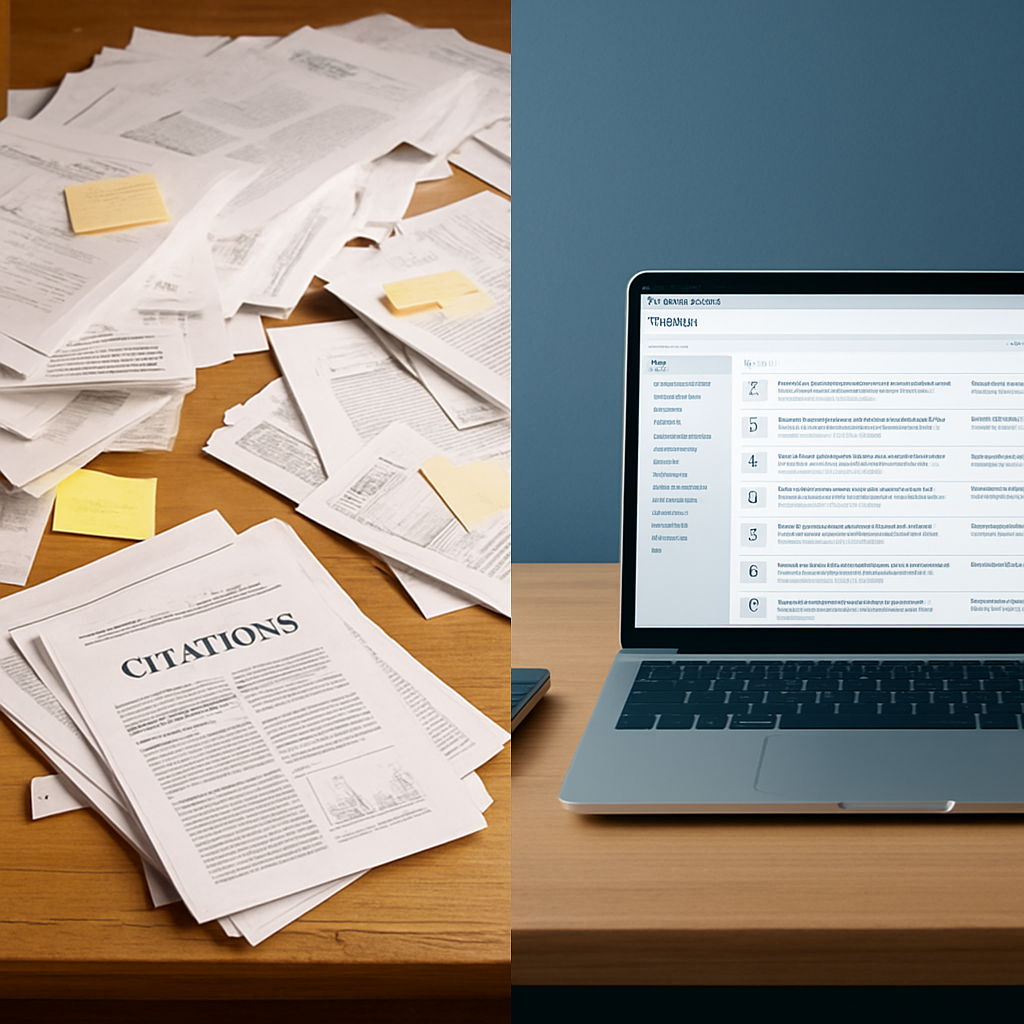
Reference Chaos to Organized Library: The 2025 Blueprint for Effortless Citation Management
Few things derail a writing sprint faster than citation chaos. The hunt for that elusive "et al. 2019" PDF, the endless style tweaks when a journal switches requirements mid-submission, the LaTeX compiler error caused by a malformed BibTeX entry from six months ago—these are not minor inconveniences. They are genuine productivity hemorrhages. A 2024 Scientometrics survey found that 58% of graduate researchers lost ten or more hours per month to reference-related tasks alone: renaming files, deduplicating entries, fixing broken DOIs, and reconciling placeholder citations that somehow survived into final drafts.
The core problem is structural. Most researchers build their citation libraries reactively, grabbing papers and dropping them into folders as they go, with no consistent naming convention, no tagging system, and no deduplication process. The library grows over months and years into a sprawling archive that is simultaneously too large to navigate and too disorganized to trust. When a deadline arrives, the researcher faces a choice between spending hours cleaning up the chaos or submitting with incomplete, incorrectly formatted references. Neither option is acceptable, and neither has to be the reality.
This guide replaces reactive accumulation with a proactive reference management system. You will learn how to capture sources completely at the moment you encounter them, build a tagging taxonomy that makes any paper findable in seconds, eliminate duplicate entries and broken links in a single session, switch between citation styles instantly without touching individual references, and insert citations across Word, Google Docs, Overleaf, and Markdown without interrupting your writing flow. Each section addresses a distinct failure mode in the typical reference workflow and explains both the best practice and how automation can accelerate it.
1. Capturing Sources Before Context Is Lost
1.1 The Moment-of-Discovery Problem
Every researcher has lived the same frustrating pattern: you find a highly relevant paper during a literature search, note the title in your memory or on a sticky note, plan to add it properly to your library later, and then never find it again. This is not a memory failure—it is a workflow failure. The moment you encounter a relevant source is when your motivation and context for why it matters are at their peak. Five hours later, or two days later, that context has evaporated. You may remember the paper exists but not why you thought it was important, which theme it addressed, or what specific finding you intended to cite.
The solution is to capture the source completely—metadata, PDF, and a brief note on its relevance—at the moment of discovery, before moving on. This requires a capture mechanism that is genuinely frictionless. If capturing a source means opening a separate application, manually entering metadata, and downloading a file, most researchers will defer the task and lose the context entirely. The capture mechanism needs to be one or two clicks from wherever you are when you find the paper, whether that is a database search results page, a journal website, a PDF emailed by a colleague, or a preprint server.
A browser extension that scrapes the full citation metadata from any academic page and adds it to your library with a single click is the most effective capture tool currently available. The best extensions also detect whether an open-access PDF exists and download it automatically, saving you the secondary task of finding the file separately. When capturing a source, always add a brief note—two or three sentences—explaining why this paper is relevant to your current project and what specific claim or finding you plan to draw on. This note transforms a dry citation record into a genuine knowledge artifact that remains useful long after the initial discovery context has faded.
1.2 Building a Tagging Taxonomy
A tagging taxonomy is the difference between a reference library you can use and one you can only browse. Without consistent tags, finding a specific type of source—all your RCTs on a given topic, all your theoretical framework papers, all the sources assigned to a particular section—requires scrolling through your entire library or relying on imperfect title-search. With a consistent taxonomy applied from the beginning, any subset of your library is instantly filterable in seconds.
A practical three-layer taxonomy covers topic, method, and priority. Topic tags classify papers by the domain they address: "self-regulation," "urban heat islands," "transformer architectures." Method tags classify by research approach: "meta-analysis," "RCT," "interview study," "agent-based modeling." Priority tags signal your relationship to the paper at this point in your project: "must cite" for sources you are certain will appear in your bibliography, "background" for papers that inform your thinking without being directly cited, and "read later" for promising papers you have not yet engaged with fully.
| Tag Layer | Example Values | Primary Use |
|---|---|---|
| Topic | "attention," "urban planning," "mRNA vaccines" | Filter by subject area during writing |
| Method | "RCT," "systematic review," "mixed methods" | Locate methodological comparisons |
| Priority | "must cite," "background," "read later" | Manage reading queue and citation coverage |
| Status | "read," "skimmed," "unread" | Track progress through your reading list |
Apply tags at the moment of capture, not retrospectively. Retrospective tagging is one of those tasks that feels important but never quite happens because it requires reviewing material you have already processed, without the motivational urgency of an immediate need. Setting up your taxonomy before beginning a project and tagging consistently from the first paper ensures your library remains navigable throughout—not just at the start.
2. Deduplication and Library Hygiene
2.1 Why Duplicate Entries Are More Dangerous Than They Look
A duplicate entry in your reference library is more than a minor annoyance. When the same paper appears twice under slightly different metadata—different title capitalization, one with a DOI and one without, one with the full author list and one abbreviated—you risk citing the same source twice under different labels, which any thorough reviewer will catch and flag. More subtly, duplicates undermine your confidence in the library itself, because if you know duplicates exist, you cannot be certain whether the record you are looking at is the canonical version or a malformed copy.
Deduplication problems compound over time and across import sources. When you import from multiple databases—PubMed, Scopus, Web of Science, Google Scholar—the same paper typically appears in each with slightly different metadata. One database may include a DOI that another omits. The title may include a subtitle in one record and not in another. Author names may be formatted differently across databases. By the time you have built a library of several hundred papers over a multi-year project, undetected duplicates can number in the dozens, and the downstream bibliography errors they cause can be costly and embarrassing at the submission stage.
2.2 A Systematic Deduplication Protocol
Deduplication should be run as a scheduled, deliberate process rather than a reactive cleanup when you notice a problem. The most reliable detection approach combines exact matching and fuzzy matching. Exact matching flags records with identical DOIs—the gold-standard permanent identifier for published work. Fuzzy matching catches records where titles are 90% or more similar, capturing the typography variants, subtitle inconsistencies, and Unicode normalization differences that exact matching misses.
When duplicates are identified, the merge decision requires human judgment about which record is canonical. The canonical record should be the one with the most complete metadata: full DOI, complete and correctly formatted author list, official journal title, correct page numbers, and the highest-quality attached PDF. Annotations and notes from both records should be merged into the canonical record before the duplicate is deleted. Running this process monthly on an active project takes under thirty minutes and prevents the accumulation of library debt that makes submission preparation so painful.
Broken DOIs are a related but distinct problem. A paper may have been assigned a DOI that was never properly registered, or a publisher may have restructured their URL scheme during a website migration, leaving old DOIs unresolvable. The repair process is to validate every DOI in your library against the Crossref API and flag any that return errors. For preprints, the DOI may not yet be assigned; these should be tagged explicitly so you can update them to the published version when it appears.
3. Citation Style Management
3.1 The Multi-Audience Problem
Academic researchers rarely publish for a single audience. A dissertation chapter becomes a journal article, becomes a conference paper, becomes a book chapter, and each venue may require a completely different citation style. APA for psychology journals, Vancouver for medical publications, IEEE for engineering conferences, Chicago for humanities, MLA for literary studies, and dozens of discipline-specific house styles in between. If your library is formatted in a single citation style, switching venues requires manually reformatting every in-text citation and every bibliography entry—a process that takes hours for any document with fifty or more references.
The correct architecture is a style-agnostic library where each reference is stored as structured data, and formatting is applied at export time as a rendering transformation. Under this model, the author, year, title, journal, volume, issue, pages, and DOI are stored separately and formatted according to whichever style sheet is currently active. Switching from APA to Vancouver is a single menu action that updates every citation in your document instantaneously, with no manual editing of any individual record.
3.2 Insertion Across Writing Environments
Different writing environments require different citation insertion mechanisms, but the underlying principle is consistent: the citation tool should feel native to the environment, never requiring you to break your writing flow by context-switching to a separate application to find and insert a reference.
In Microsoft Word, a ribbon add-in allows you to search your library and insert formatted citations without leaving the document. In Google Docs, a sidebar add-on provides the same search-and-insert functionality and works safely in collaborative documents without breaking co-authoring. In Overleaf and other LaTeX environments, a BibTeX sync that automatically pushes your .bib file when you make library changes eliminates the manual export-and-replace cycle. In Markdown-based environments, typing an @ character followed by the cite key triggers autocomplete from your library—the fastest possible insertion experience for keyboard-centric writers.
# APA 7 in-text
"Prior research has demonstrated that (Smith & Lee, 2024)..."

# After switching to IEEE
"Prior research has demonstrated that [1]..."

# After switching to Vancouver
"Prior research has demonstrated that (1)..."
The key insight is that none of these in-text formats requires manual editing—they are all generated from the same underlying structured record. Keep one master library and let format rendering happen on export.
4. Collaborative Library Management
4.1 Why File-Based Sharing Fails Research Teams
The dominant approach to sharing references in collaborative research—dropping a Zotero RDF export into shared Dropbox or emailing .bib files back and forth—creates problems that compound with team size and time. Version control breaks down immediately: when two people modify the library simultaneously, their changes conflict, and there is no reliable mechanism for determining which version is correct. Personal annotations, highlights, and PDF notes are stored locally and do not transfer when a colleague imports your export. Cite keys generated independently by different team members are often inconsistent, creating a merged bibliography that requires manual cleanup before submission.
A real-time cloud-synced shared library eliminates all three problems. Synchronization means every team member always works with the latest version of the library without any manual export-import cycle. Annotations are stored in the shared database and visible to everyone with appropriate permissions. Cite keys are generated centrally using a consistent algorithm and never conflict. Role-based access control ensures that lab members can add and annotate freely while designated curators control deletion and structural changes.
4.2 Project Sub-Libraries for Active Teams
For labs managing multiple concurrent projects, a flat shared library quickly becomes as unmanageable as having no organization at all. The solution is project-specific sub-libraries or collections that partition sources by the project they primarily belong to. A lab with three active grants might have a master library of 2,000 papers and three project sub-libraries of 200-400 papers each. Lab meetings and writing sessions focus on the relevant project sub-library. New papers are added directly to the appropriate project. The master library serves as a long-term institutional knowledge repository rather than an active working tool.
Sub-libraries can carry project-specific tag overlays on top of the global taxonomy, enabling fine-grained organization within a project without polluting the tags that have meaning across all projects. When a project concludes, its sub-library is archived rather than deleted, preserving the provenance of every citation decision for future reference, replication requests, or related follow-up work.
5. Smart Recommendations and Literature Gap Detection
5.1 Staying Current Without Information Overload
A reference library is only as valuable as its currency. A library that was comprehensive at the start of a three-year PhD program may be missing dozens of relevant papers by the time the dissertation is submitted. The challenge is staying current without drowning in daily publication floods. Manual approaches—checking journal tables of contents, managing keyword alerts across multiple databases—consume substantial time and still fail to catch papers that use different terminology than your alerts specify.
Semantic recommendation systems offer a more intelligent alternative. Rather than matching new publications against keyword lists, a semantic system compares newly published papers to the conceptual content of your existing library and surfaces only those that are genuinely close to your research focus. This approach catches relevant papers that use different vocabulary than your keywords would detect and filters out nominally on-topic papers that are conceptually distant from your actual work. Configured correctly, a daily or weekly semantic digest requires only minutes to review and still achieves higher coverage than manual keyword-based monitoring.
Literature gap detection addresses a different but related challenge: identifying areas of the research landscape that are systematically underrepresented in your current library relative to their importance. If your library has sixty papers on intervention outcomes but only four on the theoretical mechanisms underlying those outcomes, a gap alert flags this imbalance as a potential reviewer concern. Catching these gaps early—during the writing phase rather than after submission—allows you to address them proactively rather than in a revision cycle.
6. The 60-Minute Library Overhaul
6.1 Transforming a Chaotic Library in a Single Focused Session
If your current reference library is a mess—scattered across multiple tools, full of duplicates, inconsistently tagged, missing metadata for half its records—the prospect of cleaning it up can feel overwhelming enough to be indefinitely deferred. The key is to treat the cleanup as a one-time focused sprint rather than an ongoing background task. A disciplined 60-minute session using the right tools can transform a chaotic archive into a reliable, well-organized working library.
Start with bulk import: export everything from your current tools in RIS or BibTeX format and import it all into a single unified library. This will create duplicates when the same paper appeared in multiple tools, but that is fine—you will resolve them in the next step. Run deduplication second: use the automatic detection to cluster likely duplicates, review the flagged groups, and merge into canonical records. DOI repair follows: validate all DOIs against Crossref and auto-fill any that are missing or broken.
The tagging pass is the most time-intensive step of the session but produces the most lasting value. Work through uncategorized records in batches of 20, applying your three-layer taxonomy to each based on title and abstract alone. Do not re-read papers during this pass—you are categorizing, not reviewing. Papers you cannot confidently categorize get tagged "needs review" and are revisited later. By the end of the session, every record in your library should have at minimum a topic tag, a priority tag, and a read-status flag. With this foundation in place, any future session begins with a navigable, trustworthy library rather than a chaotic archive that saps confidence before you have written a single word.
Conclusion
Citation management is one of those infrastructure investments that pays dividends throughout the entire research lifecycle. A well-organized reference library does not just save time at the bibliography stage—it changes the experience of writing, because every source you need is accessible in seconds rather than minutes, and you can search across your entire knowledge base rather than relying on memory alone. The researchers who publish most consistently and with the lowest friction are almost invariably the ones who treat their reference libraries with the same care they apply to their primary data.
The practices described in this guide are not complex, but they require consistent application from the beginning of a project. Capture sources at the moment of discovery. Tag systematically. Deduplicate regularly. Keep style rendering separate from content storage. Build collaborative workflows that preserve everyone's annotations. These habits compound over the course of a project, and researchers who apply them find that reference management transforms from a source of dread into one of their most reliable research assets.
The Hidden Cost of Reference Disorganisation
Reference disorganisation has costs that extend well beyond the time spent searching for papers that should be readily findable. When the reference library is disorganised, the cognitive cost of literature-based work -- checking a claim, finding a relevant citation, building the background section of a new paper -- is elevated for every single task that involves the library. Over the course of a research career, these elevated per-task costs accumulate to a substantial total. The researcher who cannot find a paper within thirty seconds and typically takes five minutes is not just spending an additional four and a half minutes on that task; they are experiencing a level of friction that discourages literature engagement, reduces the quality of claim checking, and makes the writing process more difficult than it needs to be.
There is also a quality cost: a disorganised library does not fully capture what the researcher knows. Papers that are in the library but not findable do not contribute to the researcher's understanding in the way that papers they can readily locate and review do. The researcher who knows they have read something relevant to a current question but cannot find it in their library will either spend time searching (reducing efficiency) or proceed without consulting the relevant paper (reducing quality). Both outcomes are worse than a well-organised library that makes relevant papers immediately accessible.
The cumulative investment in building a well-organised library is substantial, which is why many researchers deprioritise it. But the cumulative return on that investment is also substantial, and the returns compound: every paper added to a well-organised library is immediately usable for future work, whereas every paper added to a disorganised library requires future reorganisation effort before it can be fully useful. The time to invest in organisation is early and continuously, not in a single large cleanup effort after disorganisation has accumulated.