

Ultimate Guide to APA Formatting (7th Edition) for Research Papers
For many students and researchers, APA formatting feels like a maze of rules: hanging indents here, italics there, a running head that’s different on page one—but only for some papers. 😵💫 If you’ve ever lost points for a misplaced comma in a reference or spent an hour wondering whether “et al.” should be italicized, you’re not alone. This guide unpacks APA Style (7th Edition) step by step so you can format with confidence and get back to the real work: communicating your findings.
TL;DR – APA 7th streamlines font choices, nixes the “Running head:” label for student papers, and simplifies citation rules. Scroll down for a one-page checklist, copy-paste citation templates, and a free tool to generate perfectly formatted references in seconds.
Why APA Style Matters
APA (American Psychological Association) Style provides a consistent framework for reporting research in the social sciences, education, nursing, business, and more. Uniform formatting:
- Enhances readability – Readers know exactly where to find key information.
- Prevents plagiarism – Clear citations credit original ideas.
- Improves credibility – Professional presentation signals rigorous scholarship.
Whether you’re submitting a journal article or a term paper, mastering APA Style ensures your content—not formatting mishaps—takes center stage.
Major Updates in the 7th Edition
| Category | 6th Edition | 7th Edition (Current) |
|---|---|---|
| Fonts | Times New Roman 12 pt recommended | Any accessible font (e.g., 11 pt Calibri, 11 pt Arial, 12 pt Times New Roman) |
| Running Head | “Running head:” label + short title on all pages | Students: page number only · Pros: short title + page number, no “Running head:” label |
| Publisher Location | Required in references | Omitted |
| Up to 7 Authors | List up to 7 authors | List up to 20 before “…” |
| DOIs | “doi:” prefix | https://doi.org/ format |
| E-books | Device/platform noted | Format like print book; include publisher |
>Pro Tip: If you learned APA years ago, double-check every template you still copy-paste—small rule changes can cost points.
General Paper Formatting
| Element | Specs |
|---|---|
| Margins | 1 inch (2.54 cm) on all sides |
| Line Spacing | Double-spaced throughout, including reference list & block quotes |
| Indentation | First line of every paragraph 0.5 in (Tab) |
| Page Numbers | Top-right header, starting on title page |
| Alignment | Left-align text, ragged right edge (no full justification) |
Title Page
Student papers need four lines, centered midway down:
- Title (bold, Title Case)
- Author name(s)
- Affiliation (university, department)
- Course, professor, and due date
Example
The Impact of Sleep Quality on Academic Performance
Alex Chen
Department of Psychology, National Taiwan University
PSY-305: Research Methods · Prof. L. Huang · 5 June 2025
Professional manuscripts replace course info with: author note, ORCID iDs, disclosures, acknowledgments, etc.
Abstract
- Length: 150–250 words (check journal guidelines).
- Format: Block paragraph, no indent.
- Keywords: Italic “Keywords:” label, then three-to-five words separated by commas.
Headings
APA uses five levels. Remember: headings are flush left → centered → indented.
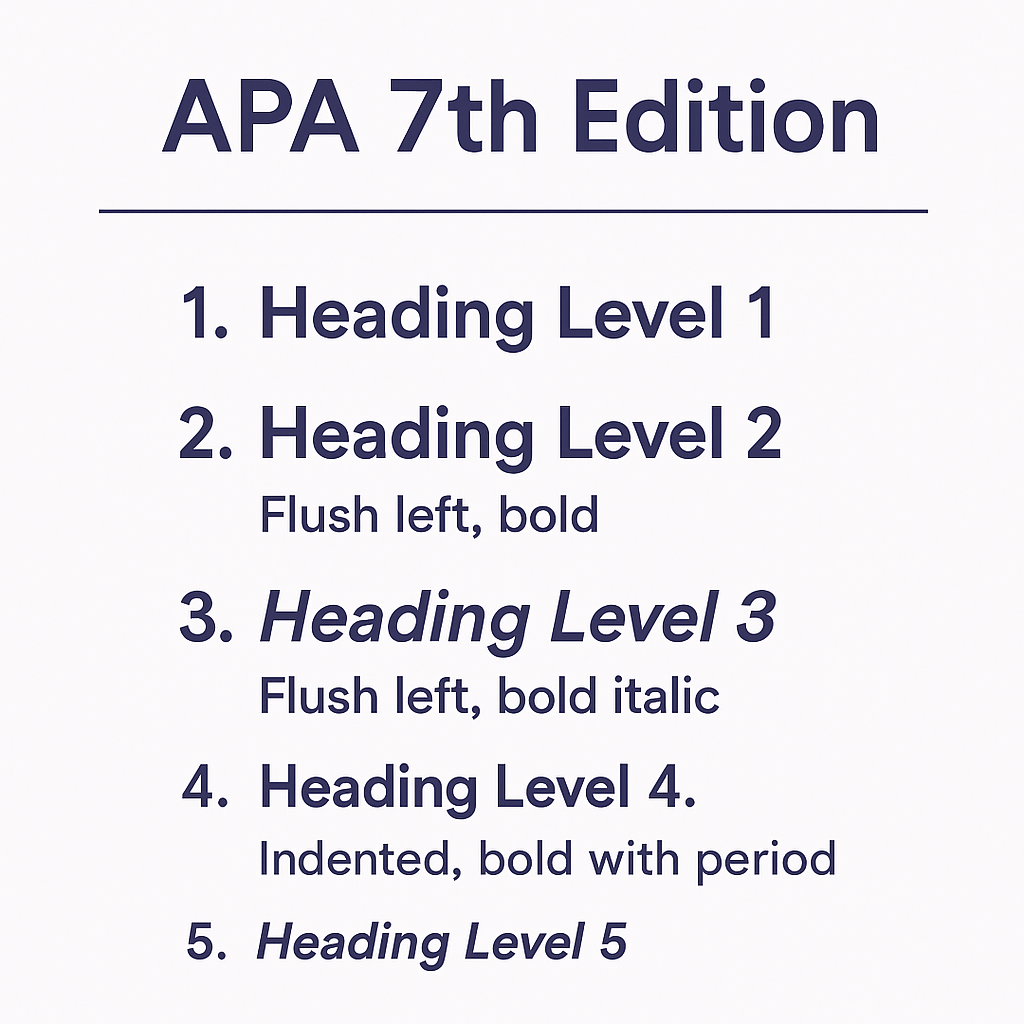
| Level | Formatting |
|---|---|
| 1 | Bold, Centered, Title Case |
| 2 | Bold, Flush Left |
| 3 | Bold italic, Flush Left |
| 4 | Bold, Indented, period. Paragraph text continues |
| 5 | Bold italic, Indented, period. Paragraph text continues |
Running Header & Page Numbers
| Paper Type | Header Content |
|---|---|
| Student | Page number only (top right) |
| Professional | Shortened title (≤50 chars) + page number |
In-Text Citations
APA uses author–date citations.
Narrative vs. Parenthetical
- Narrative: Smith (2024) argued…
- Parenthetical: …(Smith, 2024).
Multiple Authors
| Authors | Format |
|---|---|
| 1 | (Lee, 2023) |
| 2 | (Lee & García, 2023) |
| 3+ | (Lee et al., 2023) |
(et al. not italicized.)
Direct Quotes
- Under 40 words: quote in text, add page number – “…” (Wu, 2022, p. 15).
- 40+ words: block quote, indented 0.5 in, no quotation marks, period before citation.
Multiple Works in One Citation
Order alphabetically: (Chen, 2022; Lee, 2019; Martínez & Roy, 2021).
Reference List Essentials
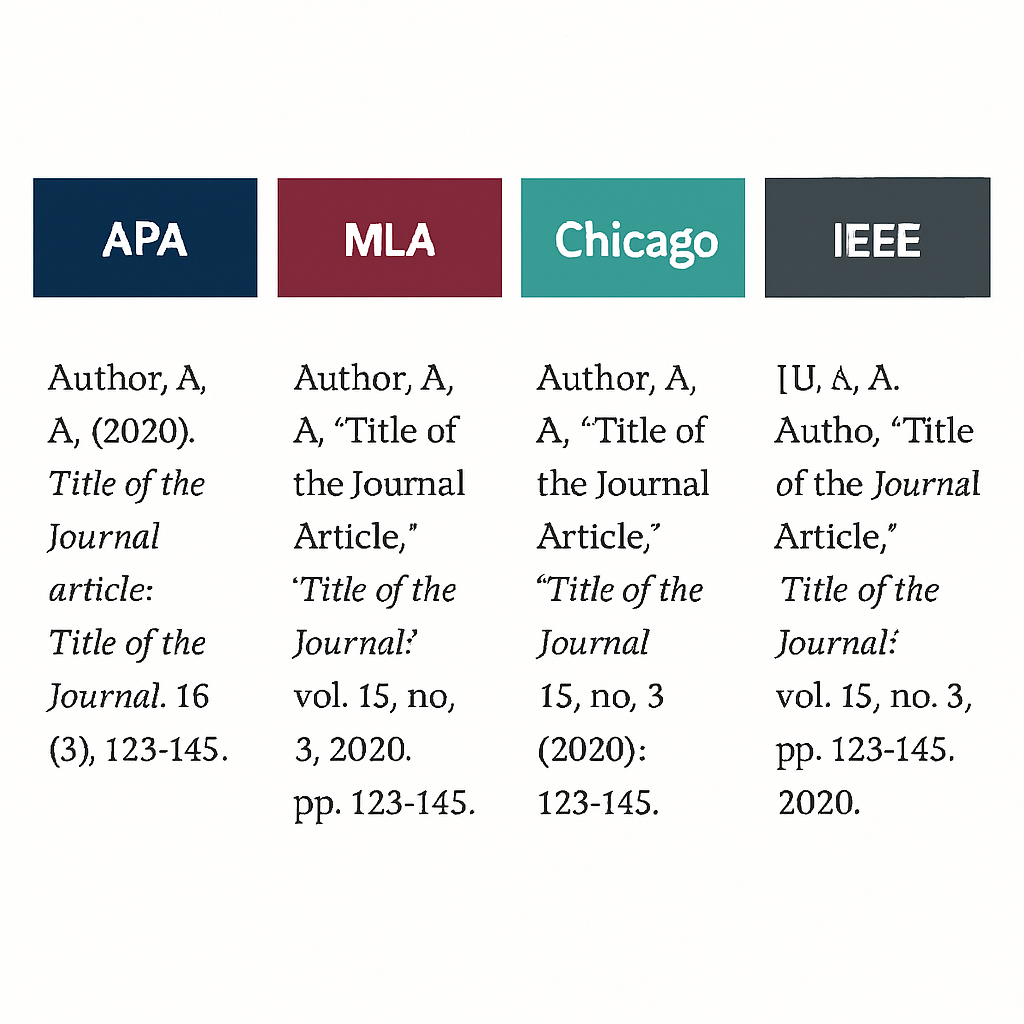
Core Formula: Author. (Year). Title. Source.
Formatting Rules
- Start on a new page titled References (bold, centered).
- Double-spaced, hanging indent 0.5 in.
- Alphabetize by first author’s last name.
- Use sentence-case for article/book titles; Title Case for journal names.
Citation Templates & Examples
| Source Type | Template | Example |
|---|---|---|
| Journal Article | Author, A. A. (Year). Title. Journal Name, _Volume_(Issue), pp–pp. https://doi.org/xxxxx | Brown, K. L., & Smith, T. J. (2024). Mindfulness and stress. Journal of Health Psychology, _29_(3), 255-270. https://doi.org/10.1037/hpy0000217 |
| Book | Author, A. A. (Year). Title (Edition). Publisher. | Cruz, P. (2023). Research Design Simplified (2nd ed.). Sage. |
| Chapter in Edited Book | Author, A. A. (Year). Title of chapter. In E. E. Editor (Ed.), Book title (pp. xx-xx). Publisher. | Lin, S. J. (2022). Survey methods. In R. Zipf (Ed.), Handbook of Social Research (pp. 45-68). Routledge. |
| Webpage | Author, A. A. (Year, Month Day). Title. Site Name. URL | World Health Organization. (2025, March 14). Climate change and health. WHO. https://www.who.int/news-room/fact-sheets/detail/climate-change-and-health |
Missing Information
- No author: Title moves to author position.
- No date: (n.d.).
- No page numbers: Use paragraph # if direct quote (para. 4).
Tables & Figures
- Number each (Table 1, Figure 1).
- Title: italic, Title Case, one double-spaced line below number.
- Note: If needed, place beneath image/table (italic “Note.” label).
- Citation: For reprinted/adapted material, add copyright statement.
Skip the Formatting Headaches with QuillWizard
Stop wrestling with indents and italics! QuillWizard's AI citation generator creates 100% APA-compliant references and in-text citations instantly. Paste a DOI, URL, or ISBN—get a perfectly formatted entry. Save hours and eliminate guesswork.
Generate APA References FreeCommon APA Mistakes (and How to Avoid Them)
- Hanging indents missing – Highlight refs → Paragraph dialog → Hanging 0.5 in.
- Ampersand in text – Use “&” inside parentheses, “and” in narrative.
- Title Case misuse – Only journals & series names in Title Case; article titles in sentence-case.
- Dead URLs – Add Retrieved Month Day, Year if page content changes over time.
- Multiple publisher locations – Drop them; APA 7 no longer requires city/state.
Rapid APA Checklist
- 1 inch margins, double spacing, readable font
- Correct title page format for student vs. professional
- Page numbers top right; running head if pro paper
- Headings follow five-level hierarchy
- All in-text citations match reference list entries
- Reference list alphabetized, hanging indents
- DOI hyperlinks start with https://doi.org/
- Tables/Figures numbered & titled, notes included
- Proofread for consistency in punctuation & italics
Nail every box above and you’re APA-ready! ✔️
Additional Resources
- APA Style Blog: Official clarifications & FAQs
- Publication Manual of the American Psychological Association (7th ed.) – The definitive rulebook
- Purdue OWL APA Guide: Quick reference & examples
- QuillWizard Citation Generator: Automated references & in-text citations
Format Faster, Write Better with QuillWizard
Formatting shouldn’t eclipse your research. Let QuillWizard handle the APA nit-picking so you can focus on insight and analysis. From auto-generated citations to smart grammar suggestions, our AI is the co-author who never sleeps.
Ready to stop stressing about style rules and start polishing your argument? Try QuillWizard for free—and watch your writing workflow transform.
Start Formatting in SecondsConclusion: Master APA, Showcase Your Ideas
Formatting may feel tedious, but it’s the frame that elevates your research. With APA 7 rules at your fingertips—and a handy AI assistant when you need backup—you’ll submit papers that look as professional as the insights they contain. Bookmark this guide, share it with lab mates, and let flawless formatting become your new research habit. Happy writing and citing!
Going Deeper: The Craft Behind the Research
Great research is not produced by chance or talent alone. It is produced by researchers who have developed disciplined habits of inquiry, a commitment to intellectual honesty, and the resilience to sustain effort through the inevitable difficulties of original work. Understanding the craft elements that distinguish high-impact research from competent research is valuable for anyone who wants to build a productive and influential scholarly career.
The most important craft element is clarity of research question. Vague research questions produce vague results that are difficult to interpret and difficult to build on. A sharply defined research question specifies exactly what is being asked, at what level of analysis, using which measurement approach, and under what conditions. Arriving at this level of specificity typically requires multiple rounds of refinement, each guided by engagement with the literature and with preliminary data. The time invested in sharpening the research question pays dividends in every subsequent stage of the research process: data collection is more focused, analysis is more tractable, and results are more interpretable and more citable.
The second craft element is methodological transparency. Research that cannot be evaluated for methodological adequacy cannot be effectively built upon, because readers cannot assess whether the findings are likely to generalise or whether methodological choices that are invisible in the paper may have influenced the results. Methodological transparency requires not just reporting what was done but explaining why: why this sample, why this measure, why this analysis rather than a plausible alternative. This explanatory transparency serves two functions: it allows readers to evaluate the adequacy of the choices, and it demonstrates that the researcher has thought carefully about the implications of their methodological decisions rather than simply defaulting to familiar or convenient approaches.
The third craft element is appropriate scope. The most effective research papers address a clearly defined question with sufficient depth to produce a genuinely informative answer. Scope that is too broad produces results that are too thin to be informative about any specific question; scope that is too narrow produces results that are informative but trivially so. Finding the right scope requires the ability to resist the temptation to answer every question raised by the data, and to focus instead on answering one question well. This focus is a form of intellectual discipline that is difficult to develop but becomes more natural with practice.
The Writing Phase: From Analysis to Argument
The transition from completed analysis to written paper is a transition from the mode of scientist to the mode of author, and it requires a different set of skills. The scientist's job is to produce accurate findings; the author's job is to make those findings intelligible and compelling to a specific audience. These are complementary but distinct tasks, and researchers who are excellent scientists sometimes struggle as authors because they do not distinguish between them clearly.
The author's primary task is argument construction: developing a coherent, evidence-based argument that answers the research question and situates the answer in the context of existing knowledge. An academic paper is not a report of everything that was done and found; it is a carefully constructed argument in which the evidence is marshalled in support of a specific claim. Evidence that does not serve the argument — no matter how interesting in itself — should be moved to supplementary materials or saved for a future paper. The discipline of argument construction is what separates a well-written paper from a data dump, and it is what makes a paper useful to readers who want to build on it.
Each section of the paper serves a specific function in the argument. The introduction establishes why the research question matters and what gap in knowledge the current paper addresses. The methods section establishes that the approach is adequate for the question asked and sufficient for the claims made. The results section presents the evidence honestly and completely, including evidence that complicates the argument. The discussion section interprets the evidence, addresses the limitations that affect the strength of the conclusions, and identifies the implications for future research and practice.
The most common weakness in academic paper writing is a mismatch between the strength of the evidence and the strength of the conclusions. Conclusions that outrun the evidence — claiming certainty where the data support only tentative conclusions, generalising to populations beyond the sample, or attributing causal relationships to correlational data — are a form of intellectual dishonesty that erodes the credibility of the research. Maintaining strict discipline about the relationship between evidence and conclusion, even when more confident conclusions would be more impressive or more publishable, is a fundamental requirement of scientific integrity.
Building on Your Research: From Publication to Impact
Publication is not the end of the research process; it is the beginning of the contribution to the field. A published paper that no one reads, cites, or builds on has made no impact regardless of its quality, and the effort invested in it is wasted from the perspective of the field's knowledge development. Understanding how to translate the quality of published work into genuine impact on the field is therefore as important as producing that quality.
The primary driver of paper impact is the quality and significance of the research question and findings. Papers that address important questions with rigorous methods and produce clear, interpretable results attract citations because other researchers find them useful as a basis for their own work. Marketing and promotion can amplify the reach of a good paper, but they cannot substitute for quality; papers that are heavily promoted but address questions of limited significance or use flawed methods will receive initial attention but will not sustain citation growth.
Presentation at conferences and seminars, particularly in the period immediately after publication, increases the visibility of new work among researchers who are actively working in the area and are therefore most likely to cite it. The personal relationships developed through conference attendance and seminar presentation often directly produce citations: a researcher who knows about your work and has discussed it with you personally is more likely to cite it than one who encountered it only through a database search. Building these relationships is therefore an investment not just in social capital but in the impact of specific papers.
Engagement with the broader public — through press releases, accessible blog posts, policy briefs, or social media — can extend the reach of research beyond the academic community and contribute to impact in policy and practice. This kind of public engagement is increasingly recognised by research funders and institutions as a valuable dimension of scholarly contribution, and the skills required for effective public communication of research are distinct from and complementary to the skills required for academic publication. Developing them is a worthwhile investment for researchers whose work has implications beyond the academy.
Going Deeper: The Craft Behind the Research
Great research is not produced by chance or talent alone. It is produced by researchers who have developed disciplined habits of inquiry, a commitment to intellectual honesty, and the resilience to sustain effort through the inevitable difficulties of original work. Understanding the craft elements that distinguish high-impact research from competent research is valuable for anyone who wants to build a productive and influential scholarly career.
The most important craft element is clarity of research question. Vague research questions produce vague results that are difficult to interpret and difficult to build on. A sharply defined research question specifies exactly what is being asked, at what level of analysis, using which measurement approach, and under what conditions. Arriving at this level of specificity typically requires multiple rounds of refinement, each guided by engagement with the literature and with preliminary data. The time invested in sharpening the research question pays dividends in every subsequent stage of the research process: data collection is more focused, analysis is more tractable, and results are more interpretable and more citable.
The second craft element is methodological transparency. Research that cannot be evaluated for methodological adequacy cannot be effectively built upon, because readers cannot assess whether the findings are likely to generalise or whether methodological choices that are invisible in the paper may have influenced the results. Methodological transparency requires not just reporting what was done but explaining why: why this sample, why this measure, why this analysis rather than a plausible alternative. This explanatory transparency serves two functions: it allows readers to evaluate the adequacy of the choices, and it demonstrates that the researcher has thought carefully about the implications of their methodological decisions rather than simply defaulting to familiar or convenient approaches.
The third craft element is appropriate scope. The most effective research papers address a clearly defined question with sufficient depth to produce a genuinely informative answer. Scope that is too broad produces results that are too thin to be informative about any specific question; scope that is too narrow produces results that are informative but trivially so. Finding the right scope requires the ability to resist the temptation to answer every question raised by the data, and to focus instead on answering one question well. This focus is a form of intellectual discipline that is difficult to develop but becomes more natural with practice.
The Writing Phase: From Analysis to Argument
The transition from completed analysis to written paper is a transition from the mode of scientist to the mode of author, and it requires a different set of skills. The scientist's job is to produce accurate findings; the author's job is to make those findings intelligible and compelling to a specific audience. These are complementary but distinct tasks, and researchers who are excellent scientists sometimes struggle as authors because they do not distinguish between them clearly.
The author's primary task is argument construction: developing a coherent, evidence-based argument that answers the research question and situates the answer in the context of existing knowledge. An academic paper is not a report of everything that was done and found; it is a carefully constructed argument in which the evidence is marshalled in support of a specific claim. Evidence that does not serve the argument — no matter how interesting in itself — should be moved to supplementary materials or saved for a future paper. The discipline of argument construction is what separates a well-written paper from a data dump, and it is what makes a paper useful to readers who want to build on it.
Each section of the paper serves a specific function in the argument. The introduction establishes why the research question matters and what gap in knowledge the current paper addresses. The methods section establishes that the approach is adequate for the question asked and sufficient for the claims made. The results section presents the evidence honestly and completely, including evidence that complicates the argument. The discussion section interprets the evidence, addresses the limitations that affect the strength of the conclusions, and identifies the implications for future research and practice.
The most common weakness in academic paper writing is a mismatch between the strength of the evidence and the strength of the conclusions. Conclusions that outrun the evidence — claiming certainty where the data support only tentative conclusions, generalising to populations beyond the sample, or attributing causal relationships to correlational data — are a form of intellectual dishonesty that erodes the credibility of the research. Maintaining strict discipline about the relationship between evidence and conclusion, even when more confident conclusions would be more impressive or more publishable, is a fundamental requirement of scientific integrity.
Building on Your Research: From Publication to Impact
Publication is not the end of the research process; it is the beginning of the contribution to the field. A published paper that no one reads, cites, or builds on has made no impact regardless of its quality, and the effort invested in it is wasted from the perspective of the field's knowledge development. Understanding how to translate the quality of published work into genuine impact on the field is therefore as important as producing that quality.
The primary driver of paper impact is the quality and significance of the research question and findings. Papers that address important questions with rigorous methods and produce clear, interpretable results attract citations because other researchers find them useful as a basis for their own work. Marketing and promotion can amplify the reach of a good paper, but they cannot substitute for quality; papers that are heavily promoted but address questions of limited significance or use flawed methods will receive initial attention but will not sustain citation growth.
Presentation at conferences and seminars, particularly in the period immediately after publication, increases the visibility of new work among researchers who are actively working in the area and are therefore most likely to cite it. The personal relationships developed through conference attendance and seminar presentation often directly produce citations: a researcher who knows about your work and has discussed it with you personally is more likely to cite it than one who encountered it only through a database search. Building these relationships is therefore an investment not just in social capital but in the impact of specific papers.
Engagement with the broader public — through press releases, accessible blog posts, policy briefs, or social media — can extend the reach of research beyond the academic community and contribute to impact in policy and practice. This kind of public engagement is increasingly recognised by research funders and institutions as a valuable dimension of scholarly contribution, and the skills required for effective public communication of research are distinct from and complementary to the skills required for academic publication. Developing them is a worthwhile investment for researchers whose work has implications beyond the academy.